
1️⃣ Exhibit Name
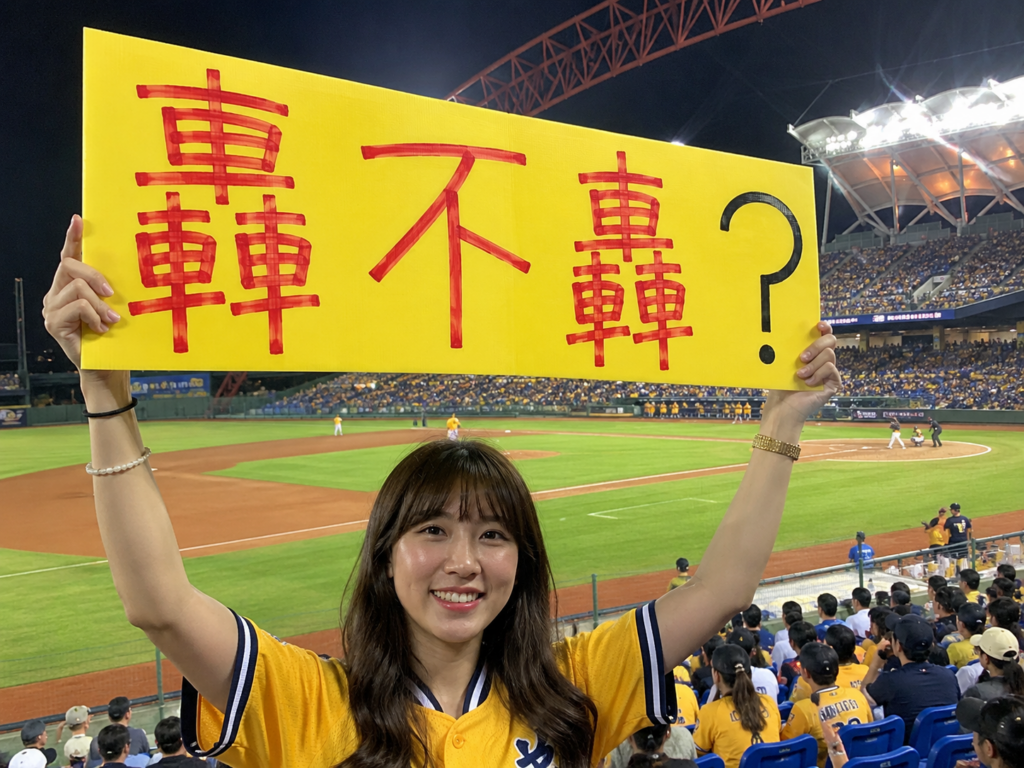
“Hōng bù hóng” Question Sign (Chinese: 轟不轟)
A playful sign asking “Will he hit a home run?” Fans wave it before a star player’s at‑bat.
2️⃣ Collection & Image
Figure 1 – “Hōng bù hóng” Sign – Camera Photo Style
A fan waving a sign with the character “轟” (hōng) and the question “轟不轟” before a star player’s at‑bat.
3️⃣ Gallery Location
Fan Culture Wing › Signs Hall › Taiwan Gallery
4️⃣ Exhibit Background
The “Hōng bù hóng” (轟不轟) question sign is a playful, uniquely Taiwanese fan sign that asks a single question: “Will he hit a home run?” The character “轟” (hōng) means a powerful blast – an onomatopoeic word for a booming explosion. The sign is typically waved just before a star player’s at‑bat, building anticipation. It is not a command (“Hit a home run!”) but a rhetorical question that fans answer together with a cheer.
The tradition emerged in the 1990s during the golden age of the Chinese Professional Baseball League (CPBL). The sign gained popularity with the rise of sluggers like Chen Chin‑feng (陳金鋒) and Lin Chih‑sheng (林智勝). Today, it is a staple in CPBL stadiums, especially during playoff games.
5️⃣ Period & Location
- Period: 1990s – present
- Location: Chinese Professional Baseball League (CPBL) stadiums (e.g., Taichung Intercontinental Baseball Stadium, Taipei Dome)

Figure 2. “Hōng bù hóng” Sign – Paper Cutting Style
An intricate paper cutting artwork of the question sign, with the character “轟” carved from red paper and suspended against a white background.
6️⃣ Material & Dimensions
- Material: Cardboard, foam board, plastic sheet – often brightly colored
- Dimensions: Typically 12″ × 18″ (30 cm × 45 cm)
- Lettering: Bold Chinese characters in black or red, sometimes with team colors (e.g., green for Uni‑Lions, red for Rakuten Monkeys)
7️⃣ Narrative Story
The Birth of a Question
Unlike American signs that command (“Hit one out!”) or Japanese signs that encourage (“Kattobase!”), the Taiwanese “轟不轟” sign asks a question. The answer is not spoken – it is demonstrated when (or if) the batter hits a home run. The sign turns the at‑bat into a game of prediction among fans.
The “轟” Character as Visual Art
The character “轟” is itself a visual spectacle – composed of three “車” (chariot) radicals, meaning a thunder of wheels. Taiwanese fans often write it in exaggerated, explosive calligraphy, with sparks or flames drawn around the edges. Some signs include a question mark or a comic‑style speech bubble.
The Chen Chin‑feng Era
During the early 2000s, Chen Chin‑feng (Taiwan’s first MLB position player) returned to CPBL and became a hero. Fans would hold up “轟不轟” signs during his every at‑bat. When he connected, the sign would be raised triumphantly. When he struck out, fans would lower it sheepishly – but the question was still asked next time.
Modern Variations
Today, “轟不轟” signs are personalized. Fans add the player’s name, number, or a nickname (e.g., “大師兄” for Lin Chih‑sheng). Some signs are double‑sided: one side reads “轟不轟”, the other side reads “轟了!” (“He homered!”) – flipped after a home run.
Think About It
- Why do Taiwanese fans prefer a question (“Will he hit a home run?”) rather than a command or encouragement?
- How does the visual design of the character “轟” (three “車” radicals) reinforce the meaning of a powerful blast?
- What does the “question” format tell us about Taiwanese fan culture – playful, suspenseful, and participatory?

Figure 3. Player Caricature LED Sign – Origami Style
A folded paper sculpture of an LED sign, with the caricature and lights represented by geometric paper folds and reflective foil.
8️⃣ Current Status & Applications
- Status: The “轟不轟” sign is a permanent fixture in CPBL stadiums, especially for star sluggers.
- Applications: The sign appears on fan merchandise (T‑shirts, towels) and social media hashtags (#轟不轟). CPBL teams occasionally distribute pre‑printed “轟不轟” signs to fans.
- Suggested companion exhibits: Display alongside “Chia You” encouragement sign and Player Caricature LED Sign.
9️⃣ Significance & Educational Value
- Significance: The “轟不轟” sign represents Taiwanese playfulness and suspense – a question that turns each at‑bat into a communal guessing game. It also showcases the visual poetry of Chinese characters.
- Educational value: Encourages visitors to explore how different cultures frame hope – as a command (US), an encouragement (Japan), or a question (Taiwan).
🔟 References
- CPBL fan traditions. Chinese Professional Baseball League official guide, 2019.
- Chen Chin‑feng and the “轟不轟” phenomenon. Taiwan Baseball Quarterly, 2015.
- The visual art of fan signs. National Taiwan Museum of Fine Arts, 2020.
- Lin Chih‑sheng’s legendary at‑bats. United Daily News, 2016.