
1️⃣ Exhibit Name
“Charge!” – The Six-Note Call to Arms
2️⃣ Gallery Location
Fan Culture Wing › Chants & Cheers Hall › USA Rally Calls Gallery
3️⃣ Collection & Image

Figure 1. “Charge!” – The Six-Note Call to Arms: A Museum Exhibition on the Global Evolution of a Baseball Rally Chant
The definitive photographic capture of the “Charge!” moment.
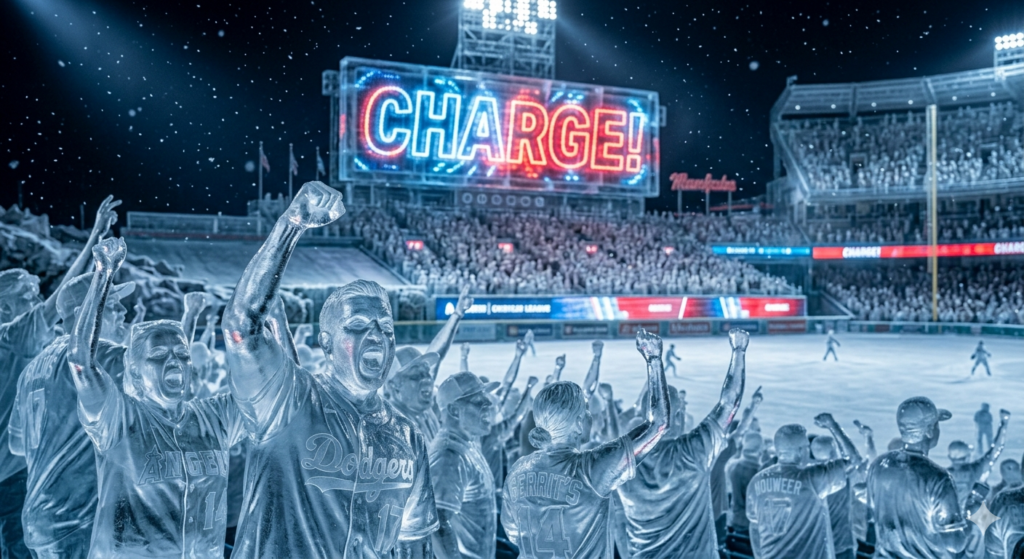
Figure 2. “Frozen Charge”
The “Charge!” moment carved entirely out of translucent crystal-clear ice, glowing under stadium lights.

Figure 3. “Pop Charge – The Organist”
The stadium organist triggering the fanfare, reimagined as a bold, vibrant pop-art comic book panel.
4️⃣ Exhibit Background
The “Charge!” fanfare is one of the most instantly recognizable sounds in all of sports — a short, six-note trumpet or organ blast that transforms thousands of individual spectators into a single, roaring voice. Unlike the rhythmic, sustained “Let’s go!” chant, “Charge!” is a lightning strike of collective energy: brief, explosive, and perfectly timed for moments of high tension — when a home team needs a rally, a pitcher is in trouble, or the game hangs in the balance.
The fanfare’s roots lie in military cavalry bugle calls — the traditional signal for soldiers to charge into battle. Its journey from the battlefield to the ballpark is a story of how war-time sounds were repurposed into expressions of communal hope and excitement.
5️⃣ Period & Location
- Period: 1946 – present (originated at USC; adopted by MLB in 1958)
- Location: Every Major League Baseball stadium, minor league ballparks, college baseball venues, and amateur fields across the United States — as well as in Japan, Taiwan, the Dominican Republic, and other baseball-playing nations
6️⃣ The Fanfare’s Structure
- Musical Pattern: A six-note fanfare — often described as “da-da-da-dum da-daaaaa” — typically played on organ, trumpet, or through the stadium sound system
- The Call: The fanfare itself is the “call”
- The Response: Thousands of fans shout “Charge!” in unison immediately after the six notes conclude
- Variations:
- The fanfare is sometimes repeated one or more times in successively higher keys, building intensity
- Some stadiums play it multiple times in a row, with the crowd shouting “Charge!” after each repetition
- May be preceded by a lead-in vamp to build anticipation
- Often accompanied by the word “CHARGE!” flashing on the scoreboard to prompt the crowd
7️⃣ Narrative Story
The Birth of a Stadium Staple
The “Charge!” fanfare was written by Tommy Walker while he was a junior at the University of Southern California in the fall of 1946. Walker, who would go on to become a prominent events director, created the six-note fanfare for USC Trojan football games. The USC marching band insists that Walker created the tune for the Trojans in the 1950s, though the 1946 date is widely cited.
For years, the fanfare was a fixture at USC football games in the Los Angeles Coliseum — played by the band, with fans shouting “Charge!” in response.
The Dodgers Bring It to Baseball
The fanfare crossed over to baseball in 1958, when the Brooklyn Dodgers moved to Los Angeles and began playing their home games in the same Coliseum. The sound was already familiar to LA sports fans — and it quickly became part of the Dodgers game-day experience.
In the spring of 1959, the Dodgers capitalized on the craze by selling 20,000 toy trumpets at $1.50 apiece (about $16 today) — each capable of playing the six notes of the “Charge” fanfare. The gimmick worked: fans across the stadium could literally sound the charge themselves.
That same year, the fanfare was heard during NBC broadcasts of Games 3, 4, and 5 of the 1959 World Series between the Dodgers and the Chicago White Sox — cementing its place in baseball history.
The Lone Buglers
Before the fanfare was piped through stadium sound systems, the tradition was more organic — and more eccentric. The cheer was originated by lone fans who would rise from their seats and blow their own bugles from the stands, triggering the crowd’s response. These independent buglers were the original architects of the stadium-wide call-and-response.
The Organist Who Spread It Nationwide
Paul Richardson, the home field organist for the Philadelphia Phillies from 1970 to 2005, is credited with popularizing the use of the “Charge!” fanfare in sports games across the country. Richardson — who also played organ for the New York Yankees from 1978 to 1983 — helped transform the fanfare from a regional USC tradition into a national sporting phenomenon. In 1980, when the Phillies won the World Series, Richardson was awarded a World Series ring alongside the players.
The Legal Battle
Not everyone agrees on who invented “Charge!” In 1978, Bobby Kent, former musical director of the San Diego Chargers, claimed he invented the fanfare while working for the NFL team. He copyrighted the tune under the name “Stadium Doo Dads” in 1980 and sued ASCAP for failing to collect royalties from MLB, NFL, NBA, NHL, NCAA, and NASCAR — asking each league to pay him $3,000. So far, only the Los Angeles Lakers have complied. But his claim is disputed by USC’s marching band, which insists Tommy Walker created the tune in the 1950s.
Others argue the notes were simply borrowed from a much older source: a military bugle call dating back to at least a German WWI army manual.
Think About It
- Why do you think a six-note fanfare from 1946 has remained so instantly recognizable for nearly 80 years, while other stadium sounds have faded?
- How does the call-and-response structure of “Charge!” differ from the rhythmic, participatory nature of “Let’s go!”? What different emotions do they evoke?
- The fanfare originated on the battlefield as a signal to charge into danger. How does repurposing that sound for a baseball game change its meaning? What does it say about how sports transform aggression into celebration?
8️⃣ Current Status & Applications
- Status: The “Charge!” fanfare is ubiquitous — heard at every MLB game, from Opening Day to the World Series, and at all levels of baseball
- Trigger: Usually played over the stadium sound system or by the organist, often accompanied by the word “CHARGE!” flashing on the scoreboard
- Timing: Typically played during critical moments — when the home team is rallying, when the opposing pitcher is struggling, or when the crowd needs an energy boost
- Variations:
- The fanfare has been adapted beyond baseball — it’s heard in basketball, football, hockey, and even robotics competitions
- It appeared in The Flintstones 1960s cartoon series, with characters shouting “Charge!” or “Charge it!”
- Scrappy-Doo used the fanfare as a lead-in to his catchphrase “Puppy Power!” in the 1980s
- The fanfare was incorporated into the jingles for Scott Shannon’s Rockin American Top 30 Countdown from 1984 to 1992
- Suggested companion exhibits: Display alongside “Let’s go [Team]!” to show the contrast between sustained rhythmic chanting and short, explosive calls. The “Global Voices” map can show how other languages express the same rallying cry.
9️⃣ Significance & Educational Value
- Significance: The “Charge!” fanfare is the purest expression of urgency and unity in American baseball. It requires no lyrics to memorize, no complex rhythm to follow — just a familiar sound and a spontaneous, collective shout. It transforms thousands of individuals into a single, explosive force in just six notes.
- Educational Value: Encourages visitors to consider how sound design shapes collective experience. The fanfare demonstrates:
- How military traditions were repurposed into civilian expressions of community
- The power of call-and-response in creating participatory culture
- How a simple, memorable sound can transcend its original context and become a universal cultural touchstone
- The democratic nature of stadium traditions — anyone can shout “Charge!” regardless of age, background, or team loyalty
- Connection to “Let’s go!”: While “Let’s go!” is a sustained, rhythmic chant that builds collective energy over time, “Charge!” is a short, explosive burst — a sudden jolt of adrenaline. Together, they represent two complementary modes of fan expression: the steady heartbeat of the crowd and the lightning strike of a rallying cry.
References
- Dickson Baseball Dictionary – “CHARGE!” definition
- Wikipedia – “Charge (fanfare)”
- NPR – “Composer Collecting When Stadiums Scream ‘Charge’”
- Baseball Almanac – CHARGE! entry
- DBpedia – Paul Richardson (organist)